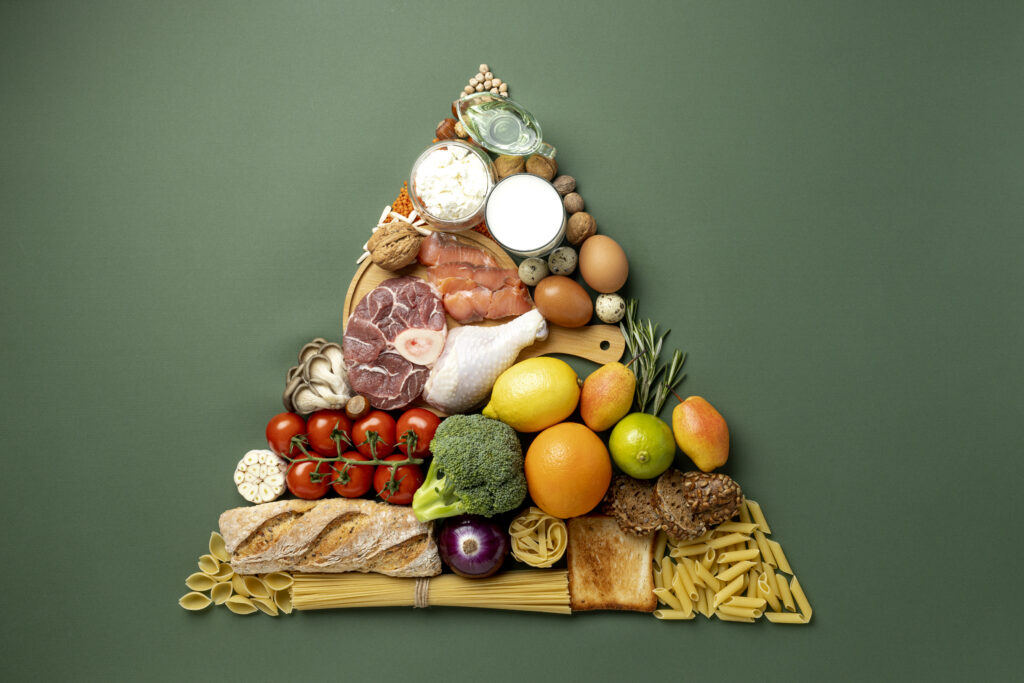
When we talk about “what’s in our food,” we’re really talking about macronutrients: the major nutrients your body needs in relatively large amounts. Understanding them — calories, carbohydrates, proteins, and fats — is key to making smarter food choices, especially when we want to prevent chronic diseases like diabetes and obesity.
Calories: More Than Just a Number
- A calorie is a unit of energy. It’s how your body measures and uses the energy it gets from food.
- The number of calories in a food depends on how much carbohydrates, protein, and fat it contains.
- But not all calories are “equal” — where they come from affects how your body uses them, how full you feel, and how they impact your long-term health.
Carbohydrates: Your Body’s Quick Fuel
- Carbs (or “carbohydrates”) are broken down into glucose, which your cells use for energy.
- There are different kinds:
- Simple carbs (sugars) — found in things like fruit juice, candy, and soda.
- Complex carbs, such as whole grains, legumes, and vegetables, are digested more slowly and give you more lasting energy.
- For people managing or trying to prevent diabetes, carbs are especially important because they directly raise blood sugar.
- One common tool is carb counting — tracking grams of carbs to help balance meals.
Protein: Building & Repairing
- Protein gives you about 4 calories per gram, same as carbs.
- But unlike carbs, protein is mostly used as a “building block”:
- It helps build and repair muscles, skin, organs.
- It makes hormones and enzymes.
- Although your body can burn protein for energy, it usually only does that when carbs and fats are low.
Fats: Why “Good” Fats Are Important
- Fat has 9 calories per gram, which makes it more calorie-dense than carbs or protein.
- Not all fats are the same:
- Unsaturated fats (like those in fish, nuts, olive oil) are healthier.
- Saturated fats (found in butter, cheese, fatty meats) should be limited.
- Trans fats (in some processed foods) are the least healthy and should be avoided.
- Why fat matters:
- It helps your body absorb vitamins A, D, E, and K.
- It’s part of cell structure and keeps your organs protected.
- Some fats are “essential” — like omega-3 and omega-6 — meaning your body cannot make them.
- Fat helps you feel fuller after you eat, which can help with weight control.
How These Nutrients Relate to Long-Term Health
- Eating too much of any macronutrient — especially in the form of highly processed foods — can lead to excess calorie intake, which contributes to obesity and increases risk for type 2 diabetes.
- On the other hand, choosing the right kinds of carbs, proteins, and fats can help:
- For carbs: favor fiber-rich sources like beans and whole grains.
- For fats: choose unsaturated fats and limit saturated/trans fats.
- Combining macronutrient awareness with portion control can guide you to a healthier diet — one that helps prevent chronic diseases and supports a longer, stronger life.
Conclusion
Understanding the components in food — calories, carbohydrates, proteins, and fats — is more than just nutrition talk. It’s about power: the power to make smart food choices that help prevent obesity and diabetes in our community. By knowing what each macronutrient does, and how to manage them, you’re taking a big step toward better health and a longer, more vibrant life.
References